When The Old Maps Stop Holding
Digital Dimwit's take on Dashavathara : 10 conditions, 10 Avatharas

A fisherman in the Sundarbans points to a patch of open water and says — that is where my school building was.
Not a metaphor. A specific patch of brown estuary, somewhere west of where Lohachara island used to be before it slipped under the Bay of Bengal in 2006. He is not yet sixty. He has watched land become sea inside one working life.
The same sentence appears in different languages across the world. Pacific island elders drive sticks into the sand each year to mark the high tide; each year, the stick moves inland. A Greenland glaciologist returns to the same fjord every summer and re-photographs the same ridge — the ice that stood there last year is now water, kilometres downstream. In Gangotri, the snout of the glacier that feeds the Ganga has retreated by more than two kilometres since the British surveyed it in 1935.
This is where it used to be.
The phrase keeps recurring because the disorder it describes is now everywhere. Slow withdrawal that any single human can observe inside one career. Loss arriving not as event but as disclosure — what was here, is no longer here, and the speed of going matches the speed of working life.
Leadership today runs inside this kind of disorder.
Not only climate — though climate is the cleanest tutor. Institutions that worked yesterday no longer hold. Trust withdraws like a coastline. Compliance frameworks designed for one velocity meet markets running at another. Partners optimise for short cycles while consequences accumulate in long ones. The flood is already underway, and the question is no longer whether we are inside one, but whether we have a grammar for it.
Most of us were not trained for such conditions.
We lead in flooding systems: too much information, too many people we answer to, too little trust, too many moving parts. We lead inside ambiguity, where every decision solves one problem and creates two more. We lead in institutions carrying old memory and new pressure, where what worked yesterday can quietly become the source of fragility tomorrow.
India produces this complexity at distinctive intensity. A country simultaneously building world-scale digital infrastructure and governing pre-modern institutional legacies. Where a single policy decision touches half a billion people. Where platform economics meets dharmic vocabulary in the same conference room. The leadership challenges here are not simpler versions of Western challenges. They are structurally different — layered, multi-speed, morally thick.
When reality is this layered, leadership frameworks built only from quarterly logic feel thin. Useful, but thin. We need frameworks that can think in time horizons longer than quarters, in moral vocabularies richer than compliance, and in social realities wider than shareholder logic. This is not East versus West. It is adequacy versus inadequacy.
That is why Digital Dimwit turns to Dashavatara.
Why this grammar? Because these ten patterns have survived two thousand years as instruction in disorder. What survives that long survives because it maps to something structural. The stories were never finally about the gods — they were always about the system states they describe.
Not as mythology for comfort. Not as cultural decoration. Not as nostalgia.
And not as reduction. These are sacred narratives first. What follows is one reading — tactical, worldly, partial — offered with the awareness that leadership lessons do not exhaust theological meaning.
As a decision grammar.
The ten avatars of Vishnu are not ten motivational stories. They are ten distinct interventions for ten distinct conditions of disorder. Each avatar appears when a different kind of breakdown emerges. Each acts with a different logic. Each leaves behind a different leadership lesson.
Matsya preserves what must survive a flood. Kurma bears unbearable load so transformation can happen. Varaha recovers what has been buried under collapse. Narasimha breaks formal rules when rules protect injustice. Vamana uses moral intelligence, not brute scale, to reset power. Parashurama corrects accumulated excess through hard pruning. Rama embodies rule-bound legitimacy under public scrutiny. Krishna leads through paradox, timing, and strategic ambiguity. Buddha transforms through compassion and inner disarmament. Kalki closes exhausted cycles so renewal is possible.
Each condition calls one avatar and rejects others. A preservation crisis is not a justice crisis. The grammar is not in the stories. It lives in the matching of condition to intervention.
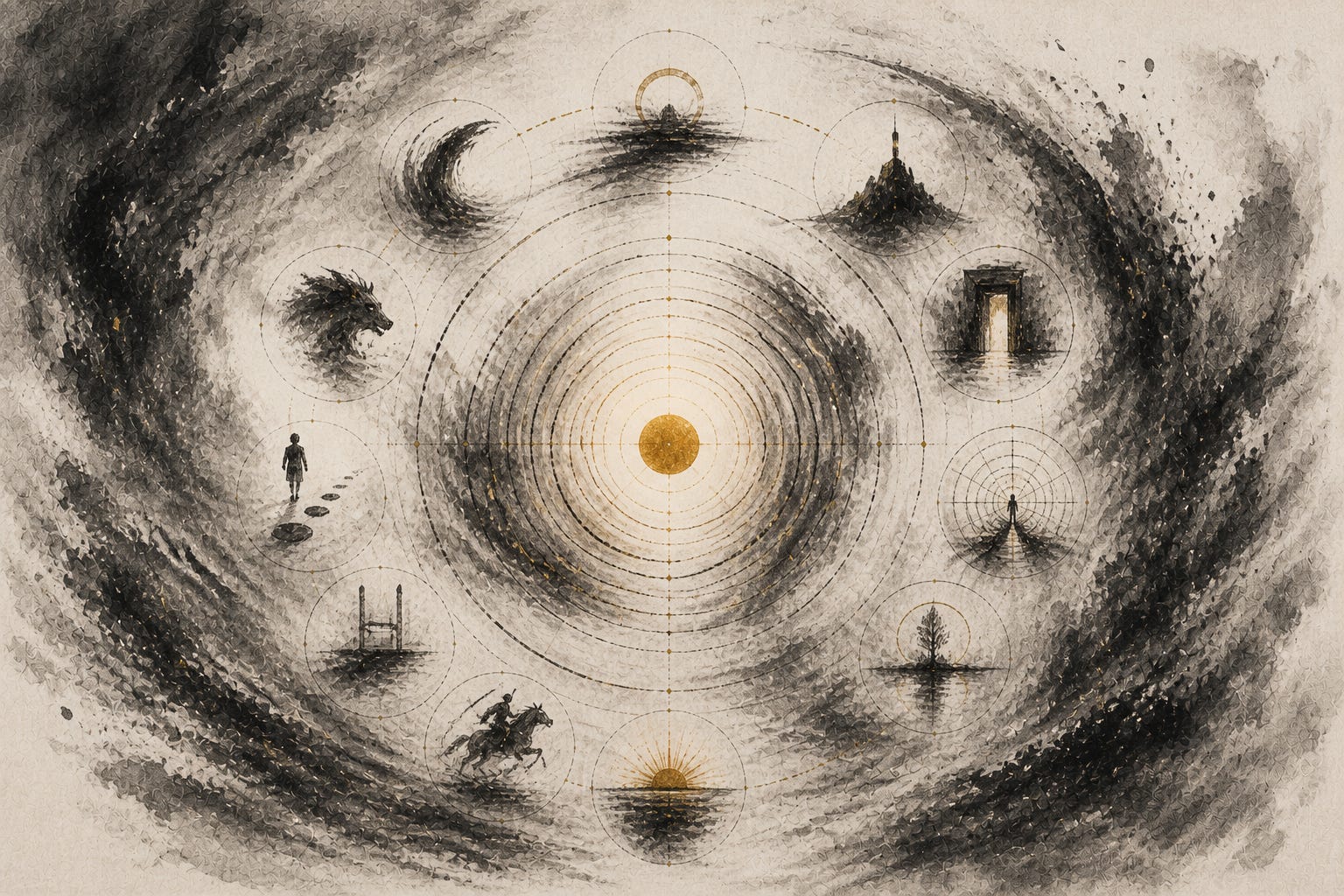
That is exactly what many modern leaders need: not one universal style, but the ability to diagnose condition and choose response.
The wrong avatar at the wrong time is costly. If your system needs Kurma and you perform Narasimha, you break trust. If your context needs Vamana and you perform Parashurama, you overcorrect. If your institution needs Buddha and you perform Kalki, you burn what could have healed.
The first discipline, then, is diagnosis.
What kind of disorder are we in? A crisis of preservation? Of support? Of justice? Of legitimacy? Of meaning?
Only after naming the disorder can leadership response become precise.
This series is an attempt at that precision.
One clarity before we proceed. I learned these stories within a Madhwa tradition context. This series does not pretend to be a final harmonised account across all sampradayas. Where avatar lists or emphases differ, I will name the difference. I would rather be honest about lineage than perform false neutrality. The same applies to Kalki — treated here as a meditation on ethical closure and renewal, not as a claim to predictive certainty.
A note on intellectual lineage. This series draws from Jaques (time-span of discretion), Meadows (leverage points), Taleb (fragility and skin in the game), Christensen (disruption), and others — frameworks whose structural insights converge with Chanakya, the Upanishads, Conway, and cybernetics. When independent traditions reach the same conclusion from different directions, that conclusion becomes harder to dismiss.
The aim is not to prove that ancient stories contain all answers.
They do not.
The aim is to build better questions. Better pattern recognition. Better judgment.
In turbulent periods, leadership is less about controlling outcomes and more about increasing system capacity: capacity to absorb shock, retain coherence, adapt with integrity, and regenerate after loss.
Dashavatara offers a language for that capacity.
Use every framework that helps. Discard every framework that blinds.
If Dashavatara sharpens leadership judgment, keep it.
If it does not, leave it.
No sentiment required.
Across the next eleven essays, we will move avatar by avatar, condition by condition, from flood to renewal. We begin with Matsya and the first question every leader eventually faces.
The fisherman pointing across his lost school is asking it without using the word.
So is the glaciologist re-photographing the ridge.
So is every leader who has watched something they were responsible for begin to come apart at a speed they did not plan for.
When the flood comes, what do you save first?
This is Essay 0 of Ten Conditions, Ten Avataars, a twelve-essay series.
Next Essay 1: Matsya — What Goes on the Boat?
Author’s note
Ten Conditions, Ten Avataars is a set of twelve Tuesday essays reading the Dashaavataara of Vishnu as a decision grammar — ten distinct interventions for ten distinct conditions of disorder.
Each essay stands on its own. Together, they build a sequence model of leadership under changing system states — preservation, support, retrieval, justice, legitimacy, ambiguity, renunciation, ending.
These pieces don’t prescribe and they don’t motivate. They diagnose. The avatars are read not as mythology for comfort but as patterns for judgment in conditions where old maps have stopped holding.
A quiet companion runs beneath the series: Mankuthimmana Kagga, D.V. Gundappa’s 945 verses of Kannada philosophical poetry. The verses are quoted as they were written, in Kannada with transliteration, because some things should be met in the language they were born in.
The writing is shaped through lived experience, learned within a Madhwa tradition context, and sharpened with the help of AI collaborators. What is said — and what is left unsaid — remains my responsibility.
Don’t know …but this reminds me of Harari’s idea of “intersubjective myths” in Sapiens — stories that persist because they encode shared coordination logic across societies and time…. It is Peter Senge, Harari, AK Ramanujam - theories which you have uniquely woven together.
Intellectual in its composition… stark in its difference from the earlier series.